
IB Programme
The IB Diploma Programme gives our Grade 11 and Grade 12 students the opportunity to receive both a Bulgarian secondary school diploma and an internationally recognised diploma, opening doors to universities in Bulgaria and around the world.
HOME / IB PROGRAMME
A global standard in education
What is IB?
- International Baccalaureate (IB) is a unique international programme designed for children and young people aged 3 to 19.
- It challenges them to develop both academically and personally.
- The Diploma Programme is a two-year pre-university course of study.
- It guarantees standardised requirements and mutual convertibility of diplomas.
A mission beyond academics
Mission of the
International Baccalaureate (IB)
- To develop inquiring, knowledgeable and caring young people.
- The aim is for young people to contribute to a better and more peaceful world through understanding and respect.
- To achieve this goal, the organisation works with schools, governments and other international organisations.
- To develop modern educational programmes and objective assessment systems.
- To encourage students around the world to become active, compassionate and curious individuals.
- To build the understanding that all people, regardless of their differences, have equal rights.
- Dual diploma. Your child graduates with both a Bulgarian diploma and an International Baccalaureate Diploma at the same time, without having to choose between applying in Bulgaria or abroad.
- An advantage with admissions committees. Universities in Europe, the USA and the United Kingdom recognise IB as a sign of critical thinking, independent research and academic maturity.
- Easier adaptation at university. Students arrive in their first year already used to writing research essays, managing their time across several higher-level subjects and working independently.
- Development beyond textbooks. Through the CAS component, students develop teamwork, initiative and responsibility through volunteering, sport and creative projects they choose themselves.
- It teaches students how to think, not what to think. Theory of Knowledge encourages students to ask questions, recognise manipulation and form their own well-argued opinion.
Subjects
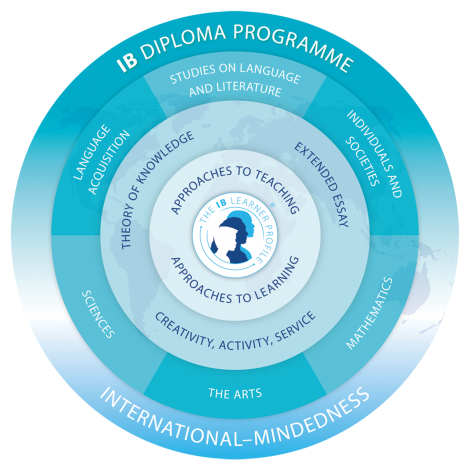
Students in the Diploma Programme choose one subject from each of the six subject areas:
- First language (Language A: Studies in Language and Literature)
- Second language (Language B: Language Acquisition)
- Social sciences (Individuals and Societies)
- Natural sciences (Experimental Sciences)
- Mathematics
- The Arts, or an additional subject from the previous five areas
Alongside the subject areas, the IB Programme develops transversal learning skills through Approaches to Learning: thinking skills, research skills, communication, social skills and self-management skills – abilities that remain with students long after graduation.
Level of study
Based on their strengths, personal preferences and plans for future development, students choose:
- three Higher Level (HL) subjects – with more teaching hours and more challenging content
- three Standard Level (SL) subjects
This flexibility allows each student to deepen their knowledge where they have interest and ambition, without overloading the remaining subjects.
The core of the programme
The three core components develop the student beyond exams:
- Extended Essay – an independent research essay of up to around 4,000 words on a topic chosen by the student. It is a first real experience in academic research and an invaluable start before university.
- Theory of Knowledge (TOK) – an interdisciplinary course that teaches students not what to think, but how to think: to critically analyse the nature of knowledge and how it is acquired across different areas of knowledge.
- Creativity, Action, Service (CAS) – an extracurricular component through which students take part in creative activities, physical activity and voluntary community service of their own choice.
Subject groups
Studies in Language and Literature
Bulgarian Literature – HL, SL; English A, Language and Literature – HL, SL
Language Acquisition
English B – HL; Spanish B – SL; German B – SL
Individuals and Societies
History – HL, SL; Business Management – HL, SL; Environmental Systems and Societies – SL, HL; Psychology – SL
Sciences
Biology – HL, SL; Chemistry – HL, SL; Environmental Systems and Societies – SL; Physics – SL, HL
Mathematics
Mathematics, Analysis and Approaches – HL, SL
The Arts
Visual Arts – HL, SL
Type of assessment
- A combination of internal and external assessment.
- External assessment forms around 70% of the final grade in each subject.
Process
- During their studies, students complete specific tasks in their chosen subjects.
- Some tasks are assessed internally by teachers and are later subject to external moderation.
- Other tasks are sent directly to designated external IB examiners.
- At the end of the programme, students sit subject examinations that are entirely externally assessed.
Diploma and points
- A minimum total of 24 points, together with satisfactory performance in the three required core components, is needed to receive the IB Diploma.
- The maximum possible result is 45 points.
- Additional information about the Diploma Programme is available at www.ibo.org.
Language requirements
- The official language of instruction for the IB Diploma Programme at BRITANICA Park School is English.
- Candidates for the Diploma Programme are expected to have reached C1 level in English according to the Common European Framework of Reference for Languages (CEFR).
Academic requirements
- Candidates take tests in English, Bulgarian and Mathematics.
- A result above Very Good 5.00 in all three subjects is considered successful.
- Candidates also submit their first-stage high school diploma record.
- Grades in subjects chosen for Higher Level (HL) study cannot be lower than Very Good 5.00.
- Grades in subjects chosen for Standard Level (SL) study cannot be lower than Good 4.00.
- The Diploma Programme is also open to international students who do not need the Bulgarian high school diploma – they are not required to take a Bulgarian language test.
Application stages
Candidates submit the following documents:
- Completed application form.
- Motivation letter in English.
- Academic transcript for Grades 8 and 9, as well as first-term results from Grade 10.
- Tests in English, Bulgarian and Mathematics; international candidates do not take the Bulgarian language test.
- Interview.